
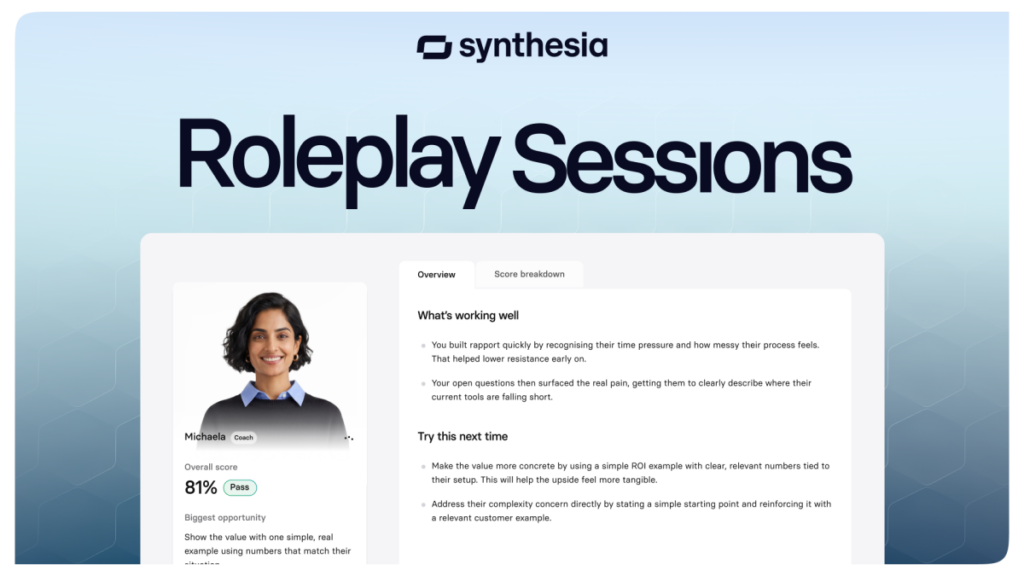
Synthesia’s AI training platform is moving beyond videos into live coaching
For years, Synthesia’s pitch was to use AI to help enterprises create interactive training videos, in minutes, for a fraction of the cost normally associated with developing corporate educational materials. The startup’s newest product is making a different bet — that the real moat in enterprise AI isn’t just generating content, but in proving that it worked.
On Wednesday, the British startup launched Roleplay Sessions, an interactive training product where employees can practice high-stakes conversations like sales pitches, performance reviews, and customer complaints with an AI avatar that talks back, pushes back, and then scores them against a rubric.
Roleplay is the first release under a broader “Sessions” platform Synthesia plans to expand into other formats, including job interviews and candidate screening, TechCrunch has exclusively learned.
The launch comes as enterprises take a harder look at whether their AI spend is paying off. Citing a meta-analysis of learning research, Synthesia argues that most corporate training — including, implicitly, its own core video product — stops short of actually changing behavior. The trainings tend to inform and demonstrate, but what really pushes someone into actually learning something is doing that thing, along with feedback.
“Video performs way better than text or sending out a document,” Synthesia CEO and co-founder Victor Riparbelli told TechCrunch. “But for most things, we learn the best by actually practicing something rather than just reading it.”
Roleplay also moves Synthesia into a more defensible position. The company’s avatar and voice technology are proprietary, but the underlying reasoning intelligence is OpenAI’s. By tacking on a layer that includes rubrics, performance data, and analytics, Synthesia is positioning itself less as an AI avatar company and more as a performance-management platform with a video front end.
“From a managerial executive layer, we’re seeing huge interest in mapping out the talent in their company in a way that’s been really difficult to do before,” Riparbelli said. “If you have your entire sales team practice with an AI role player, you can get very granular data on how your sales force is doing overall.”
Synthesia already has a few early Roleplay customers with scaled commercial rollouts, including “one of the top three companies by market cap in Europe, one of the top five Fortune 100, and one of the biggest recruitment companies in the world,” per a company spokesperson.
The two most popular use cases involve training sales teams and leadership — programs like practicing how to sell a product or have a difficult conversation. Much of it is soft skills training, Riparbelli said.
As with Synthesia’s main product, customers can either create their own training programs on the platform or enlist the help of Synthesia’s consultants to build a bespoke solution that relies in part on whatever training documents and context the company already has.
Roleplay is an enterprise offering for now, but the goal is to offer it more widely to small businesses, prosumers, and potentially educational institutions in the next few months as inference costs continue to fall. Riparbelli believes products like Roleplay represent the next phase of enterprise AI adoption, where companies care less about whether AI looks good in a social media demo and more about proving it generates measurable business outcomes.
When you purchase through links in our articles, we may earn a small commission. This doesn’t affect our editorial independence.