
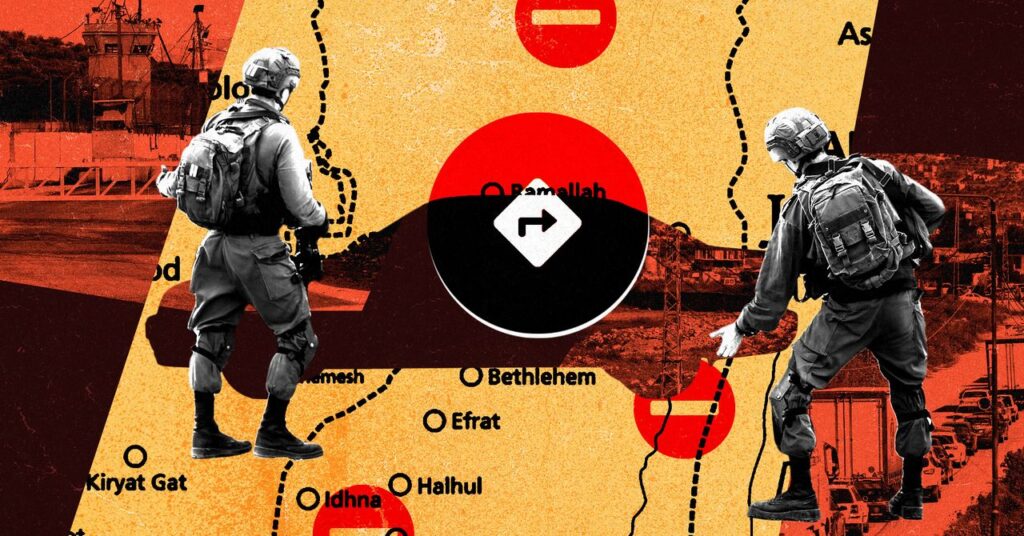
Inside Google’s Failure to Make Google Maps Work for Palestinians
The success was short-lived, however. Days after Google updated the West Bank mobile map with Lozano’s work, Israeli newspaper Haaretz published an article criticizing a “glitch” impacting Israeli drivers. It reported that Google Maps was now avoiding routes on Israeli-built roads that cross into the West Bank, designed to let Israelis travel through the territory quickly. Google responded to the article saying that it was aware of these problems and was “working to fix them.”
Weeks later, by December 2025, the company had retracted important parts of the West Bank map update. Google confirmed this to WIRED. A current employee close to the company’s work in the region said that he was not aware of any communication, even internally, about Google’s decision to do this.
Now, drivers routing from Tel Aviv to a major settlement in the West Bank could travel without once being informed that they were leaving Israel and entering the West Bank. Although Google’s map includes a static dashed line marking a 1949 “armistice agreement line,” drivers using the mobile app are given no notification that they are crossing it. From a user experience perspective, Google Maps made much of the West Bank seem to Israeli drivers like it was Israel.
What did remain of Lozano’s efforts were notifications when users were entering the parts of the West Bank that contain the towns and cities where most Palestinians live. The updates effectively amount to warnings for Israeli drivers before entering Palestinian population centers.
The former Google manager with knowledge of the project was unsurprised that Google backtracked part of Lozano’s work: A complaint from Israel is all it would take for Google to alter the West Bank map, he believes. Google did not deny this. The company has become increasingly entangled with Israel in recent years through its acquisition of two Israeli companies, Wiz and Waze, and the signing of a joint $1.2 billion cloud infrastructure contract with Amazon Web Services and the Israeli government, known as Project Nimbus, that rights groups claim has enabled war crimes in Gaza. Today, as Israeli military and settler violence reaches unprecedented levels in the West Bank, the stakes of a wrong turn have never been higher for Palestinians there. Yet, Google’s West Bank map continues to cater exclusively to Israelis. “Any claims of Google Maps showing bias in this region are false,” Google’s Bourdeau tells WIRED. “We are constantly working to improve the map for all users.” In response to WIRED’s questions about military and settler actions, the Israeli military says that “the security forces operate” in the West Bank “to provide security to all residents.”
Amazon did not respond to a request for comment.
Not only are there indications that the world’s leading tech company has in effect ceded the West Bank to Israel; in at least one instance, Google populated its map with information drawn from an illegal settlement authority. Google tells WIRED that it does not have a policy against using or purchasing data from settlers. As recently as this November, a road closure update appeared on the map that had been sourced from the “Binyamin Council,” which is responsible for governing nearly 50 Israeli settlements and outposts occupying the West Bank in violation of international law.
“Israel’s changing the facts on the ground, and the map is then adapting to represent that,” says Zena Agha, a scholar of colonial cartography. “They’ll put that on their maps because that’s what the Israelis are saying, and then it de facto creates a reality in itself.”