
ICE’s Internal Watchdog Is Now Investigating Online Critics
Voting was already underway when the ICE agents arrived at a polling site in Syracuse, New York, during the state’s primaries in June. The agents were there to see Paigelynn Gonyea, a poll worker who says they were concerned about an Instagram post she had supposedly made in January “doxing” an ICE agent. The only post she could find was one she had made crediting the Minnesota Star Tribune for identifying Jonathan Ross, the ICE agent who shot and killed Renee Good during the federal incursion in Minneapolis this winter, and calling for his indictment.
The agents at the poll site asked Gonyea to sign a warning notice that said it was unlawful to “threaten to assault, kidnap and/or murder” federal officials or their immediate family members in an effort to impede that federal official’s work. The form also requested that she remove her post “and/or discontinue” her behavior.
“My signature would have been an admission of guilt,” Gonyea says. “I refused to sign it.”
ICE did not respond to a request for comment for this story.
The incident, which was first reported by local news outlet Syracuse.com, was unsettling in many ways, but one part stuck out to Gonyea: the warning notice said it was sent by ICE’s Office of Professional Responsibility.
“That office is supposed to be for internal investigations,” says Gonyea, “and now they’re using their own internal departments on American civilians.”
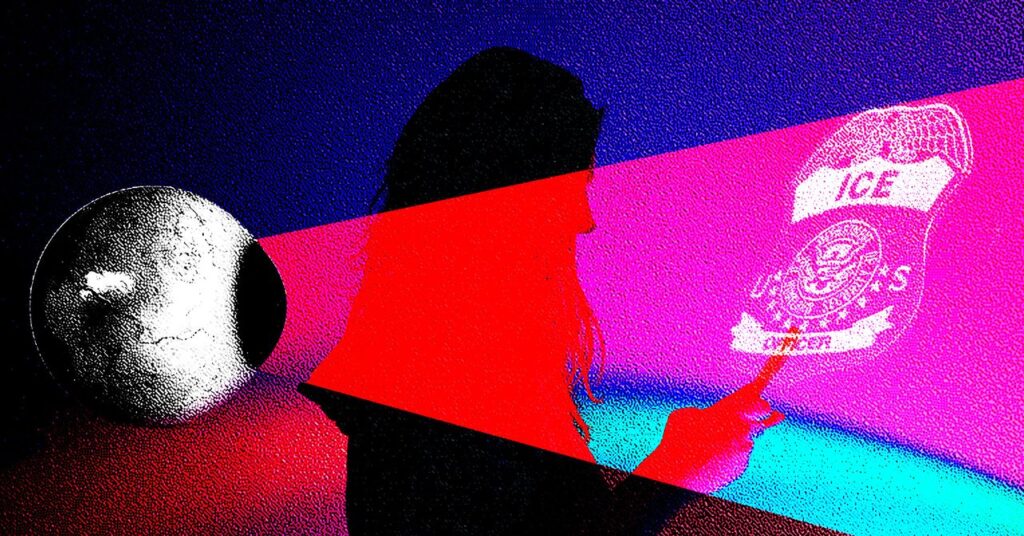
OPR is supposed to act as an internal watchdog. It’s responsible for inspecting detention facilities, investigating allegations of employee and contractor misconduct, and processing security checks for new applicants. On its site, it says it also protects against “external threats” by managing badge access to buildings and maintaining the agency’s network security. But lately, court documents indicate, it appears to be pursuing more civilians like Gonyea for what they say online.
In a court declaration filed in April, an ICE official said that between January 2025 and March 2026, OPR investigated 131 cases involving “incidents of doxing and threats directed towards ICE employees nationwide.”
It’s unclear how many of those cases resulted in criminal charges. WIRED was able to identify only one instance when OPR was credited for its investigative work in a case where the Justice Department accused a California man of harassing an ICE attorney and her mother. The DOJ alleged that the man, who pleaded guilty, used to live in the same building as the mother and that he started his harassment campaign in January 2024, well before President Trump took office. ICE did not respond to questions about whether other cases have been brought based on OPR’s work or how many additional cases OPR has opened since March.
“It takes a lot to actually convict someone for their speech, and it’s only possible in very limited circumstances,” says Laura Moraff, a staff attorney at the ACLU’s Speech, Privacy, and Technology Project. “People do have a First Amendment right to criticize the government and to do that online and to do that anonymously.”
OPR was behind at least one of the flurry of administrative subpoenas sent to tech companies in recent months in an effort to unmask online critics. In court filings, lawyers for the poster argued that the subpoena, which asked for the poster’s name, address, telephone number, and other details, violated the poster’s right to free speech. The government withdrew the subpoena rather than trying to litigate its merits.