
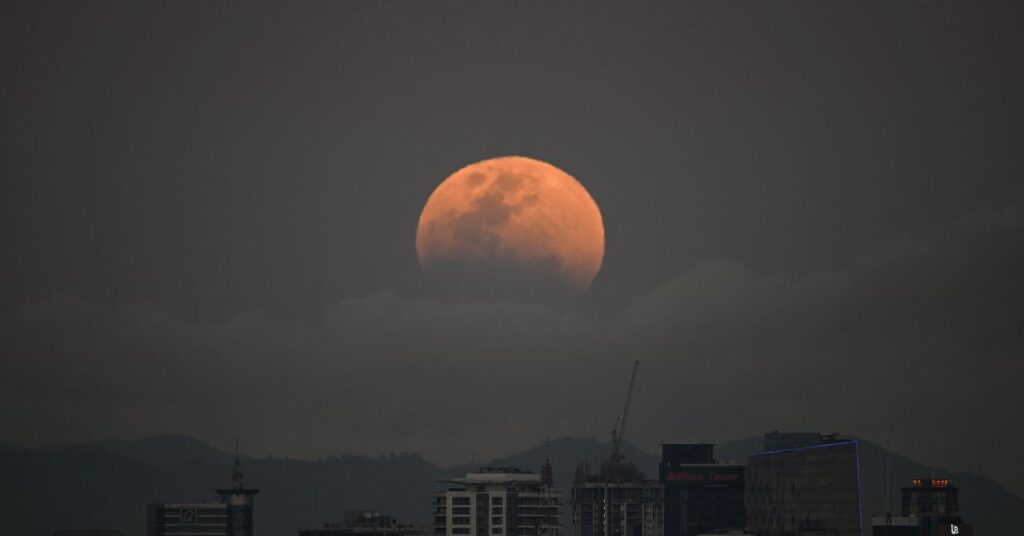
How to See the Partial Lunar Eclipse and Blood Moon on August 27
If you missed the spectacular solar eclipse earlier this month, you have a chance to catch another stunning astronomical phenomenon: a partial lunar eclipse and “blood moon” that will occur on Thursday night into Friday early morning.
Earth’s shadow will cover nearly all of the bright lunar disk and will cast a reddish or orange hue on the moon’s surface.
The partial phase will last about three hours and 18 minutes. At its peak, it will have a threshold magnitude of 0.93, meaning that approximately 93 percent of the moon’s diameter will be within the darkest part of Earth’s shadow. Here’s what to expect and how to view it.
August Lunar Eclipse Timeline
While Europe was the prime viewing spot for the recent solar eclipse, the Americas will be the best location for viewing Thursday’s lunar event. The peak will occur at night across North and South America. Europe will also get a glimpse, but viewers there will have to wait until dawn. Even then, opportunities will be limited. In locations across Spain, for example, the breaking of day and the moon’s low altitude will make observation difficult. (Don’t feel too bad for folks there, though. They got a stunning view of the total solar eclipse a few weeks ago.)
Below is a list of the best times to observe the lunar eclipse in different cities, using local times for when the event will reach its peak. If you’re wanting to get the full experience, though, you can look toward the sky earlier and plan to stick around after.
- New York: 12:14 am
- Chicago: 11:14 pm
- Denver: 10:14 pm
- Los Angeles: 9:14 pm
- Mexico City: 10:14 pm
- Lima – 11:14 pm
- Buenos Aires: 1:14 am
- London: 5:12 am
What Causes a Blood Moon?
During a lunar eclipse, the moon usually takes on reddish tones. If the eclipse is total, it’s called a blood moon. The reason? Sunlight passes through Earth’s atmosphere before hitting the moon’s surface. During that passage, some of that light—specifically the blue wavelengths—is filtered out by the atmosphere leaving only the red end of the spectrum to reach the moon. The eclipse will be full enough that the effect will be pronounced.
“It’s as if all of the world’s sunrises and sunsets are projected onto the moon,” explains NASA.
How Can You Best View a Lunar Eclipse?
Unlike solar eclipses, you don’t need special eye protection to observe them. You can look directly at the moon during all phases of the event. However, there are a few tips that can significantly enhance your viewing experience.
The first is basic but very useful: Get away from areas with light pollution and try to find an unobstructed view of the sky. The roof or terrace of a house can be a good observation spot. Even if you can’t get out of the city, though, you’ll still be able to see the eclipse (weather permitting).
You can also pick out your spot to post up before the eclipse reaches it maximum extent. Observing earlier will allow you to appreciate how the Earth’s shadow gradually advances across the lunar surface.
If you have binoculars or a telescope, you should absolutely grab them or get set up beforehand. They’ll allow you to see more details of the moon and the advancing shadow across its surface. If you have a telescope, pay special attention to the boundary between the illuminated part of the moon and the area covered by Earth’s shadow. As the shadow advances, you’ll be able to see how it crosses craters, mountains, and other features.