
Brazil Crypto Seizures Skyrocket 600% to $14 Million in 2025
Key Takeaways
- Brazil’s Federal Police seized $14M in illicit crypto, marking a 6x increase from the numbers in 2024.
- Chainalysis notes this $14M is a tiny fraction of the $100B in crypto circulating within Brazil’s market.
- To fix these flaws, the Central Bank of Brazil relies on Resolution BCB 520 to restrict future market crimes.
Brazil Registers Large Rise In Illegal Cryptocurrency Seizures
Brazil, one of the largest cryptocurrency economies in the world, has tightened its oversight on cryptocurrency crime, resulting in large volumes of digital assets used for illegal purposes being seized.
According to data collected by Valor Econômico, over 71 million reais (nearly $14 million) in cryptocurrency was seized in connection with crimes, 6 times what was seized in 2024.
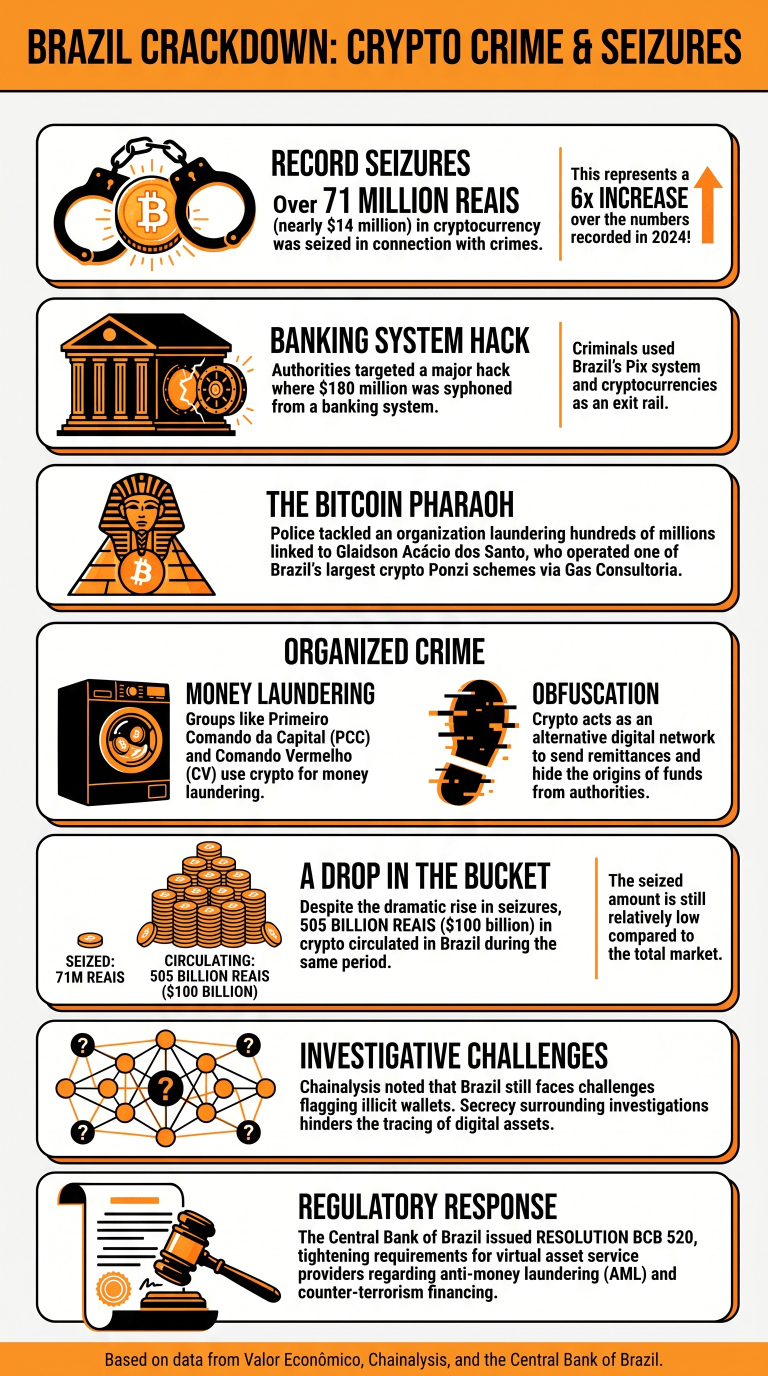
Two high-profile cases surfaced last year, with the Federal Police seizing bitcoins and dollar-pegged stablecoins in both. The first one is related to a hack that targeted a banking system and used Pix and cryptocurrencies as an exit rail for part of the $180 million syphoned.
The second case tackled an organization that laundered hundreds of millions linked to the Brazilian so-called Bitcoin Pharaoh, Glaidson Acácio dos Santo, who operated one of the largest cryptocurrency ponzi schemes in Brazil through Gas Consultoria, a cryptocurrency investment platform.
Other criminal groups have also been reported to use cryptocurrency for money laundering, including the Primeiro Comando da Capital (PCC) and the Comando Vermelho (CV). Crypto’s main use case for these groups is to send remittances using alternative digital networks and obfuscate the origins of these funds from Brazilian authorities.
Nonetheless, even as the number has risen dramatically, it is still relatively low. 505 billion reais ($100 billion) in crypto circulated in Brazil during the same period, with no benchmark to determine if any of these funds were used for criminal purposes.
Chainalysis’s commercial director, Drey Dias, stated that the Brazilian system still faces challenges in digital assets’ investigations. This causes problems when flagging wallets involved in these cases. “The secrecy surrounding investigations on the subject also hinders this work,” he concluded.
Last year, the Central Bank of Brazil issued Resolution BCB 520, which tightened the requirements for virtual asset service providers regarding anti-money laundering and counter-terrorism financing measures.