
Border Wall Construction Threatens 6,000 Years of History on Private Lands
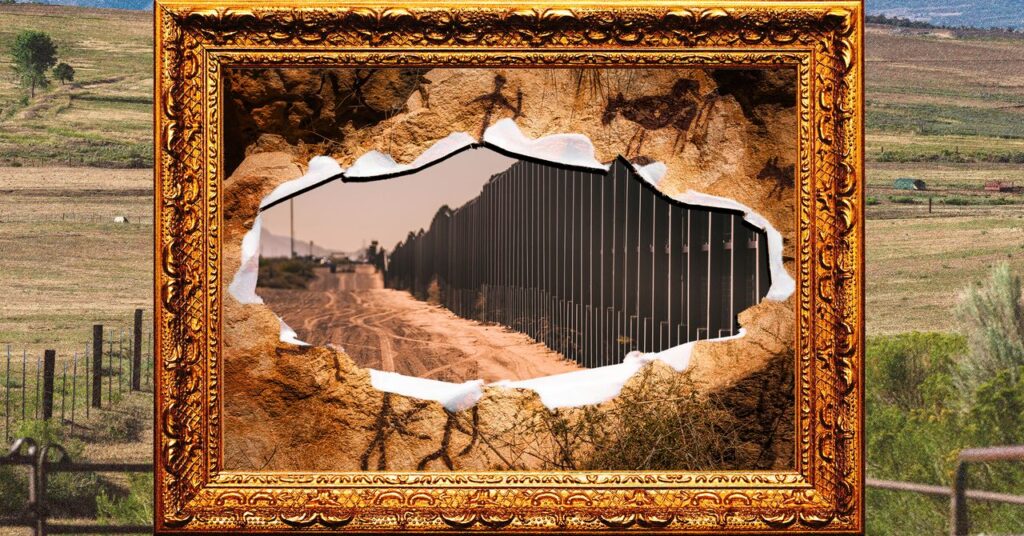
Outrage has exploded over border infrastructure that recently began tearing up pristine desert landscapes in Big Bend National Park. But there’s a quieter battle taking place on private lands in Texas, where the US border wall is set to cut across some of North America’s richest archaeological sites, digging up ancient indigenous artifacts and fracturing millennia-old rock art in its path.
The US Department of Homeland Security and Customs and Border Protection awarded billions of dollars in contracts this year toward the construction of a wall and other barriers in West Texas along a remote 500-plus-mile (800-plus-kilometer) riverfront expanse of the US-Mexico border that includes Big Bend National Park and other idyllic parklands.
Bipartisan backlash against border wall construction in the national park was swift, ultimately prompting DHS to scuttle plans for a 30-foot steel bollard wall, instead replacing it with miles of riverside vehicle barriers and 200-plus miles of road construction. Bulldozers began clearing along the Rio Grande corridor near Santa Elena Canyon on August 6.
Construction has since been paused in the park in response to lawsuits. But the agency is still planning to construct the wall, as well as a web of road construction, over mountains and across canyons outside the national park. That includes private property that ranchers and other landowners say have archeological sites worth protecting, too. And they’re concerned that construction of the wall will bifurcate their own land and damage archeological sites, many of which have yet to be fully studied.
Archeologist Bryon Schroeder has been digging on rancher Jeff Fort’s property for two years. Schroeder runs Sul Ross University’s Center for Big Bend Studies, a research program dedicated to studying the cultural, historical, and archeological legacy of the region. He removes 4 inches (10 centimeters) of sediment at a time, and his meticulous digs have uncovered pottery and melted adobe slick building material from as early as the year AD 800. He’s found turquoise, too, and marine shells, both signs of trade outside the region. Evidence shows the site is related to Paquimé, an UNESCO World Heritage site that’s 200 miles away in Mexico.
Schroeder’s dig site, Canta Recio, is directly in the path of the proposed wall. Some of it is set to be bulldozed over. If the wall is built, other parts of the site will also become effectively inaccessible.
Schroeder likens Canta Recio to how Egyptians set up shop along the Nile, surmising the site was settled four or five times between 800 and 1400 by groups who were likely drawn to fertile land afforded by routine floods. Of course, those floods also mean that groups were eventually forced to move on when the Rio Grande overtopped its banks, only for another group to eventually settle the area once the silt firmed up. A settlement, a flood, an exit, on repeat.
“There’s some bigger, cooler sites up the river that are just insane,” Schroeder said. “They have so much pottery, they have Mesoamerican copper bells, they have turquoise. They have all sorts of crazy stuff.”
The paradox facing Schroeder and other archeologists: They can’t fully measure what’s at risk because many of the archeological sites exist on private ranches and have never been studied.
That means construction may erase history before anyone gets to record it. A Customs and Border Protection spokesperson told WIRED that the agency is conducting environmental and cultural reviews to minimize impacts and balance operational needs with responsible land stewardship.
But previous studies haven’t stopped historically important sites from being sentenced to destruction. A 30-foot bollard wall is set to go right through the Polvo site, in Redford, Texas, which is home to a prehistoric village complete with burial ground dating back to the 1300s. The same site also has evidence of a Spanish mission that was built in the 1600s. Eagle Nest Canyon in Langtry, one of the most significant and intensively studied archeological sites in all of Texas, is also slated to see some form of barrier erected through it. That site includes the southernmost bison jump site in the US, where Native Americans hunted the animals en masse by funneling them over a cliff.