
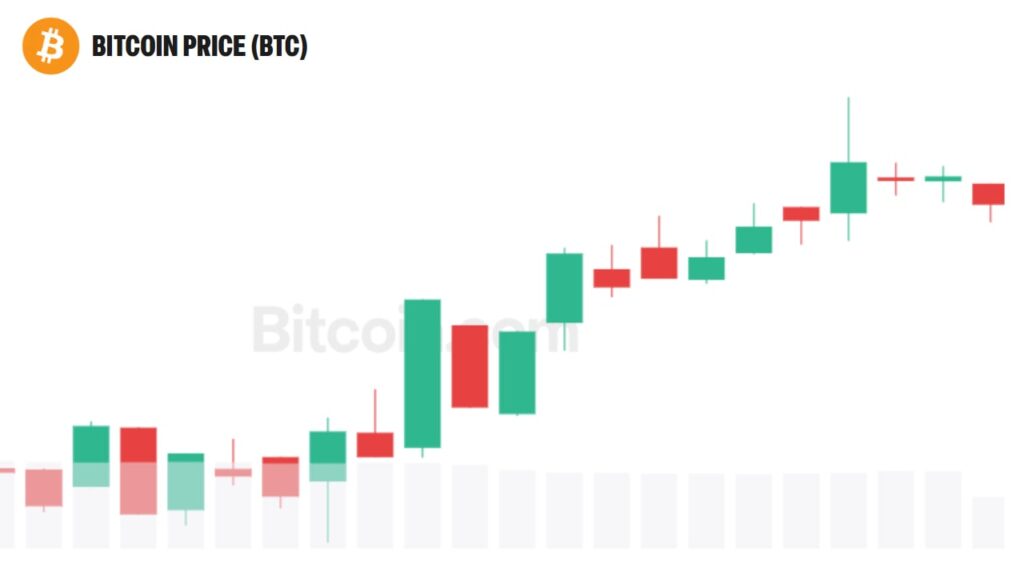
Bitcoin Eyes $125K as Galaxy Says Bear Market Has Ended
Key Takeaways
- Galaxy identified favorable conditions for bitcoin to retake $125,000.
- The firm concluded that bitcoin’s bear market ended in June.
- Galaxy linked the accumulation phase to patterns preceding past advances.
Galaxy Sees Favorable Setup for $125K Bitcoin
Bitcoin had a favorable setup for retaking $125,000, Galaxy argued in research published Oct. 26 after it was sent to clients Oct. 22. Alex Thorn, head of firmwide research at the digital asset financial services company, based the case for bitcoin’s recovery on reduced selling pressure and resilient investor demand.
At the time of writing, bitcoin traded at $80,762.07 on Bitstamp, up 1.09% over the previous 24 hours. Thorn stated:
“Bitcoin has proven its ability to run to at least $125K, and we see no reason why it can’t retake that level, and indeed the setup looks favorable.”
His assessment placed the recovery within a broader market transition. Thorn added: “We think the bear market ended in June and that bitcoin is in the accumulation phase that has preceded every prior advance.”
Recovery Signals Meet a Shift in Ownership
An August study had identified the 50-week moving average as a recovery threshold. Galaxy’s October analysis highlighted four historical recoveries following at least 20 weeks below that average. Each regained its prior all-time high within 33-83 weeks.
September supplied that technical milestone when bitcoin crossed $84,000 after regaining its 50-week average. Through Oct. 18, it had recorded five consecutive weekly closes above the average after spending 44 weeks below it.
Onchain indicators reinforced the assessment: the 53% maximum drawdown was shallower than earlier bear markets, while bitcoin remained above the network’s aggregate onchain cost basis. Short-term holders were approximately 9% above their average acquisition cost, without substantial profit-taking.
In July, Ki Young Ju, CEO of blockchain analytics firm Cryptoquant, said ETF and corporate buyers were absorbing older holders’ sales. Galaxy subsequently found that spot bitcoin exchange-traded funds (ETFs) added 87,000 BTC after the June low.
Institutional demand persisted despite trading firms retreating: nine firms reduced ETF exposure by 68,000 BTC, while other reporting institutions collectively added 20,000 BTC between September 2025 and June 2026. Monthly movement of coins dormant for at least five years fell to 34,000 BTC so far in 2026 from 67,000 BTC in 2024.
Debt Supports the Thesis as Risks Remain
Government borrowing strengthened Thorn’s argument for an asset with predetermined issuance. Under the network’s shared validation rules, bitcoin’s issuance is limited to approximately 21 million coins. His assessment cited $40.44 trillion in federal debt, a $1.99 trillion annual deficit, and Morgan Stanley’s expected $570 billion in AI-related debt issuance during 2026.
Investor attention favored stablecoins and tokenization, resembling earlier periods when institutions embraced blockchain applications while overlooking bitcoin. Stablecoin supply had expanded 129% since early 2024 to $304 billion, which Thorn viewed as capital remaining within crypto.
Potential setbacks included AI competition for investment capital, AI-assisted theft, a technology downturn affecting risk assets, and future quantum computing vulnerabilities. Galaxy also highlighted defensive upgrades and industry funding.
Thorn concluded:
“We believe the bottom is in, selling pressure has diminished, the debasement case has strengthened, and the crowd has left: these are all reasons we remain bullish on bitcoin.”
The assessment would weaken following a weekly close below the 50-week average, valued at $76,540 in the Oct. 22 analysis, without recovery within a month. Other triggers included ETF holdings below 1.22 million BTC, credible timing for a quantum computer capable of breaking Bitcoin’s cryptography, or U.S. fiscal consolidation.