

AI Was Predicted to Destroy Philippine Call Centers. Why Is the Industry Still Growing?
When generative AI took off, Silicon Valley executives rushed to predict the rapid extinction of customer support. OpenAI CEO Sam Altman famously declared that customer service jobs would soon be “totally, totally gone.” For the Philippines, where the Business Process Outsourcing (BPO) industry accounts for over 8% of national GDP and employs nearly two million people, the prediction is an existential crisis.
Yet the predicted collapse never materialized.
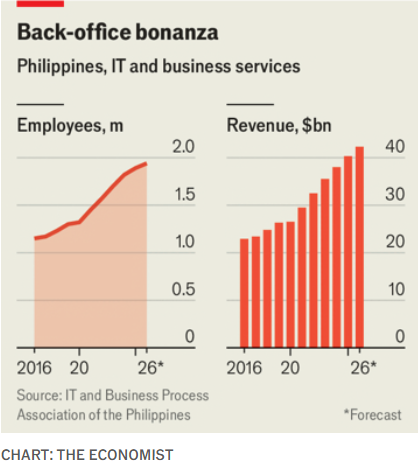
Philippine offshore BPO revenue is projected to reach $42.3 billion in 2026, up from $40 billion in 2025, with employment continuing to climb toward 1.96 million full-time workers.
Instead of replacing human workers overnight, generative AI has created a surprising dynamic: it is functioning as an intelligence multiplier. Rather than being rendered obsolete, offshore agents are using AI tools to handle higher-complexity work faster. This, in turn, drives up revenue even as the long-term safety net of entry-level jobs begins to contract.
The Augmentation Paradox: Why Humans Aren’t Going Away
The primary reason AI has failed to wipe out Philippine BPOs lies in the reality of actual customer support. While AI chatbots excel at answering straightforward questions, real-world customer service involves edge cases, billing disputes, complex technical support, and frustrated human beings.
Therefore, companies managing critical operations, such as multi-million-dollar medical diagnostic equipment or sensitive healthcare records, remain unwilling to trust fully autonomous AI agents with high-stakes customer relationships.
At the same time, tools like ChatGPT are making offshore staff drastically more effective. Agents in Manila rely on AI assistants to instantly draft clean, professional emails in non-native languages, allowing them to resolve issues in minutes rather than hours. Because employees are fixing issues faster, BPO providers have been able to raise their hourly billing rates, boosting total industry revenue.
Moving Up the Value Chain
This productivity boost is shifting the scope of offshore work coming to the Philippines. Beyond traditional call answering, Philippine workers are increasingly taking on specialized back-office roles, including legal contract summarization, medical insurance eligibility checking, financial accounting, and AI model oversight.
“Supposedly, more work is getting offshored because AI levels up our lower-paid workers, allowing them to take on more jobs that they normally wouldn’t have the skill for,” wrote Luis Buenaventura, crypto entrepreneur and chief strategy officer of Talino Fintech Foundry. Also reflecting on the sector’s unexpected momentum, he shared:
“We never imagined the transition timeframe where AI would be just good enough to augment humans, instead of completely replacing them.”
Industry numbers confirm the shift. The IT and Business Process Association of the Philippines (IBPAP) reported that the sector added roughly 80,000 jobs in 2025 alone. Much of this expansion is coming from Global Capability Centers (GCCs), which are in-house offshore centers established by multinational banks, healthcare providers, and technology firms looking for specialized, AI-assisted talent.
The Catch: Disappearing Entry-Level Rungs and AI Supervision
While overall revenues and specialized roles remain healthy, the industry’s trajectory shows signs of long-term friction.
The lowest rung of BPO work, known as “tier one” tasks, such as basic data entry and routine inquiry routing, is steadily being automated away. Historically, entry-level call center positions provided millions of Filipinos with a direct path from minimum wage into the middle class. With those entry-level roles vanishing, new workers face a much steeper skill barrier to enter the industry.
Acknowledging this shift, IBPAP recently lowered its long-term growth forecasts. While the industry previously projected reaching 2.5 million workers by 2028, it has recalibrated its best-case target to 2.14 million “AI-enabled” professionals.
Meanwhile, AI integration is making existing jobs more demanding. BPO companies are deploying AI tools to analyze call quality in real-time, grading agents on every interaction and enforcing higher productivity targets.
AI has not destroyed the Philippine BPO industry as predicted, but it has reshaped the nature of the job. Workers must now compete alongside and be managed by the algorithms.
This article is published on BitPinas: AI Was Supposed to Destroy Philippine Call Centers. Why Is the Industry Still Growing?
What else is happening in Crypto Philippines and beyond?