
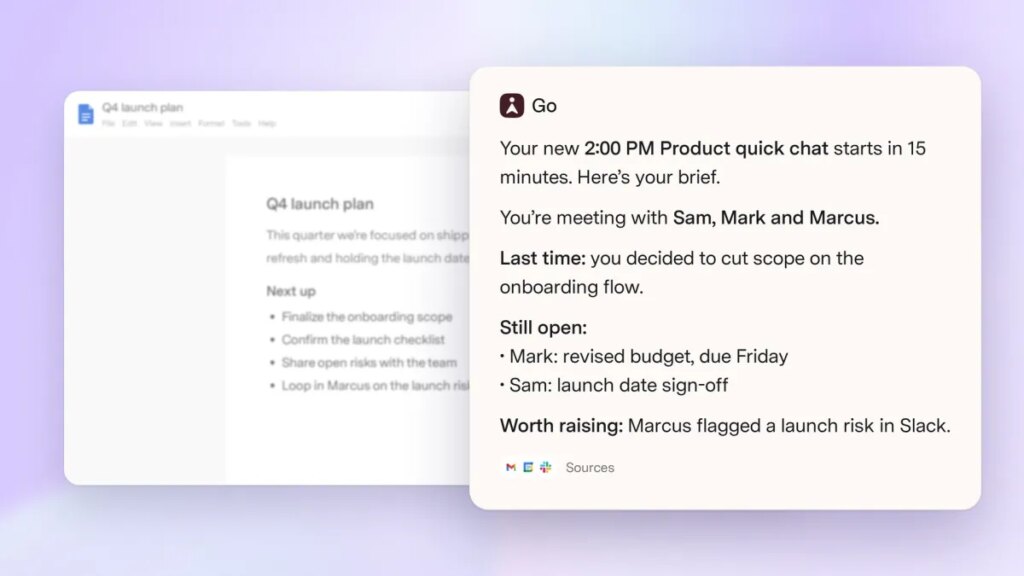
Superhuman pushes its Go assistant everywhere
Productivity apps are simultaneously trying to feed more context to their AI tools while also making those AI assistants available in every nook and corner of their products. Superhuman (formerly Grammarly) is going in the same direction with the rollout of features, including a personalized Go assistant, making agents available in Docs, and third-party agent integrations.
While some of the company’s AI features have faced criticism, Superhuman started pushing its Go assistant after its rebranding last year. With the new rollout, it is making Go learn context across different apps and give better personalized suggestions for prompts. Superhuman is revamping its onboarding flow to let users connect their preferred tools and load context about their work upfront.
The assistant works inline with the cursor — just like Grammarly does — and also manages other agents. Superhuman is also making the agent proactive, which means it looks for your schedule, keeps an eye on your email, and even drafts responses. The updated Go agent also learns users’ writing styles and responds accordingly in email and Docs.
The productivity company is adding 20 new connected agents, including DeepL, Legora, Amplitude, Databricks, and Blackboard, through its Go SDK.
The company is also thinking about adding AI to different products, including Docs and Superhuman Mail. In Docs, all Go agents work natively, and you can set them off to work on different tasks in the background. Users can also set routines to trigger workflows based on events.

Until now, Mail has used AI as its central tool, which is being replaced by Go. Users can also do enterprise search by using data from the company knowledge base and connected tools. Go also uses this context to form drafts and organize the inbox across Google and Outlook accounts.
Superhuman acquired notetaker Fathom in September to add more context to its suite. The company is now rolling out live collaborative notetaking, which would be shared across the team. Plus, Go can now make decisions post-meeting, like forming an initial draft of a proposal.

The company’s CEO, Shishir Mehrotra, said that Go has had good momentum with over 1 million active users. There are a host of agents now that are vying for users’ attention on both the personal and professional front. Mehrotra thinks that while Go is more work-focused, it can help with personal emails and schedules.
“One of the reasons why these assistants have been popular is that they treat you as a whole person and recognize that we need to cover both extremes. Go is definitely more work-focused than some of the tools coming out of the pure consumer ecosystem. It doesn’t mean we draw the boundary at helping you with your personal tasks or helping you with your calendar or all of your email,” he told TechCrunch over a call.
While Go might not directly compete with the likes of Instinct, Muse, and Fo, Superhuman wants users to choose its assistant over something like OpenAI’s Dots or Claude Duet.
When you purchase through links in our articles, we may earn a small commission. This doesn’t affect our editorial independence.