
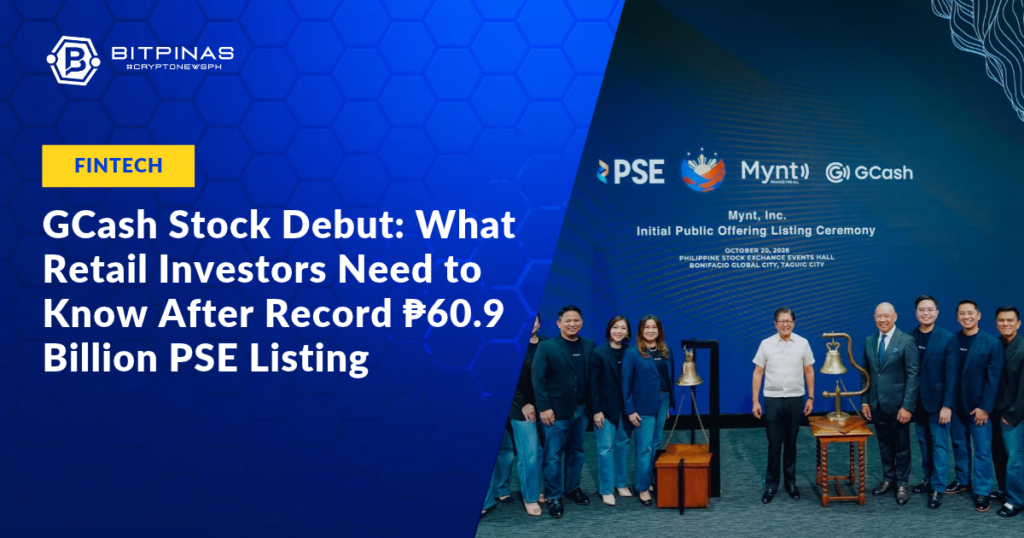
GCash Stock Debut: What Retail Investors Need to Know After Record ₱60.9 Billion PSE Listing
For hundreds of thousands of Filipinos, buying company shares used to require piles of notarized paperwork, physical bank branch visits, and steep account minimums that kept everyday earners on the sidelines. Last week, it took little more than a smartphone screen and a few taps inside an app to secure equity in the largest corporate debut the Philippine Stock Exchange has ever seen.
Now that your portfolio shows an allocation of Mynt, Inc. (trading under the ticker GCASH) priced at ₱6.60 per share, the experience shifts from digital checkout to public market realities. (Read More: SEC Approves GCash Parent Mynt’s ₱92.3B IPO Targeted for October 20 Listing)
Holding shares in a publicly traded tech company is fundamentally different from parking savings in a high-yield digital deposit or storing money in an e-wallet. Your balance is no longer fixed as it now moves each trading session based on order flow, quarterly performance metrics, and broader economic sentiment.
Here is what you need to understand about holding your position, tracking company milestones, and navigating the market from your phone.
1. Daily Trading Mechanics: Price Swings and Board Lots
When you open your trading app during market hours (9:30 AM to 3:00 PM PST), your portfolio balance will fluctuate in real time.
Unlike an e-wallet wallet balance, which only changes when you send or receive funds, stock prices reflect what buyers and sellers agree to pay at any given second. On the PSE, stock movements are bounded by trading bands: a single stock cannot rise more than 50% (the ceiling) or fall more than 30% (the floor) in a single trading day.
If you decide to buy additional shares or cash out later, keep board lots in mind:
- The PSE requires shares to be traded in standardized minimum bundles.
- For a stock priced between ₱5.00 and ₱9.99, the minimum board lot is 100 shares.
- At ₱6.60, the minimum order size to buy or sell is ₱660 (100 shares), meaning you cannot trade fractional single shares on the main board.
2. What Mynt Is Doing With the ₱60.9 Billion
Mynt raised ₱60.9 billion (~US$967 million) in this listing, giving the company an initial market valuation of ₱441.5 billion (~US$7.0 billion). That instantly positions the e-wallet operator as the seventh-largest domestic listed firm in the country, surpassing Monde Nissin’s previous ₱52.2 billion record set in 2021.
A company goes public to raise capital for expansion. For GCash, those funds are earmarked for three primary initiatives:
- Credit and Lending Expansion: Scaling its lending arm, Fuse Lending, which provides micro-loans and credit lines to underbanked consumers and small businesses.
- Technology Infrastructure: Investing in fraud detection, cloud infrastructure, and core payment stability to reduce downtime during high-traffic payroll periods.
- Regional and Wealth Capabilities: Expanding its micro-investment, insurance, and remittance channels to drive higher average revenue per active user.
As a shareholder, your returns over the medium to long term depend largely on how efficiently management turns that capital into sustained net profit.
3. Dividends vs. Reinvestment: Managing Return Expectations
Many traditional Philippine blue chips such as telecommunications carriers, power utilities, and real estate investment trusts (REITs) routinely return a significant portion of their profits to shareholders as quarterly cash dividends.
Fast-growing technology firms typically follow a different playbook. In their initial years on public exchanges, fintech platforms often retain the bulk of their net income to fund user acquisition, loan books, and product development rather than distributing large immediate cash payouts.
If you are holding GCASH expecting regular dividend income similar to a utility stock or bond, you should monitor upcoming board declarations closely. The primary driver of value for fintech stocks is usually balance-sheet growth and platform monetization, not fixed-yield distributions.
4. Financial Disclosures: The Dates That Matter
As a public shareholder, you no longer have to rely on tech blog rumors or press releases to understand how the company is performing. The PSE requires strict, regular disclosures:
- Quarterly Reports (SEC Form 17-Q): Filed within 45 days after the end of each fiscal quarter, detailing revenue, lending defaults, active user trends, and net income.
- Annual Reports (SEC Form 17-A): A comprehensive operational review and audited balance sheet released after the close of the financial year.
- Unscheduled Disclosures: Any material event—such as major regulatory adjustments from the Bangko Sentral ng Pilipinas (BSP), executive resignations, or large technical outages must be posted directly to the PSE EDGE disclosure platform.
Checking these filings gives you direct access to the actual operational metrics behind the app you use every day.
5. Cashing Out: Understanding Fees and Taxes
If you eventually decide to sell your position through GStocks PH or any accredited online broker, your gross payout will not match your simple share price multiplication. Every sale on the PSE carries transaction charges:
- Stock Transaction Tax (STT): Charged on the gross selling value. Under recent capital market reforms, this rate stands at 0.1% (lowered from the previous 0.6%).
- Brokerage Commission: Typically 0.25% of the transaction value, plus 12% VAT on that commission.
- Market Clearing and Exchange Fees: Small fractions paid to the PSE, Securities Clearing Corporation of the Philippines (SCCP), and the Securities Investors Protection Fund (SIPF).
These deductions are calculated automatically by your brokerage platform before the remaining net proceeds land back in your cash wallet.
Disclosure: AI has been used to help assist in developing this article.
This article is published on BitPinas: GCash Stock Debut: What Retail Investors Need to Know After Record ₱60.9 Billion PSE Listing
What else is happening in Crypto Philippines and beyond?