

Strategy Says MSTR Delivered 42% Annualized Return Since Bitcoin Standard, Even as Its Treasury Sits Underwater
Key Takeaways
- Strategy says MSTR posted a 42% annualized return since adopting bitcoin reserves on Aug. 10, 2020.
- The firm’s 843,775 BTC treasury, bought for $63.69 billion, sat about 17.9% underwater.
- Saylor unveiled Net BTC and BTC Hurdle ARR metrics on July 24 to reframe the bet for shareholders.
A Long-Term Bet, Restated
Strategy Executive Chairman Michael Saylor’s company touted its multiyear stock performance this week, telling followers that MSTR has delivered a 42% annualized return since the software firm pivoted to a bitcoin-based treasury strategy on Aug. 10, 2020. The figure beats bitcoin (BTC), the so-called Magnificent Seven group of large-cap technology stocks, and the S&P 500 index over the same stretch.
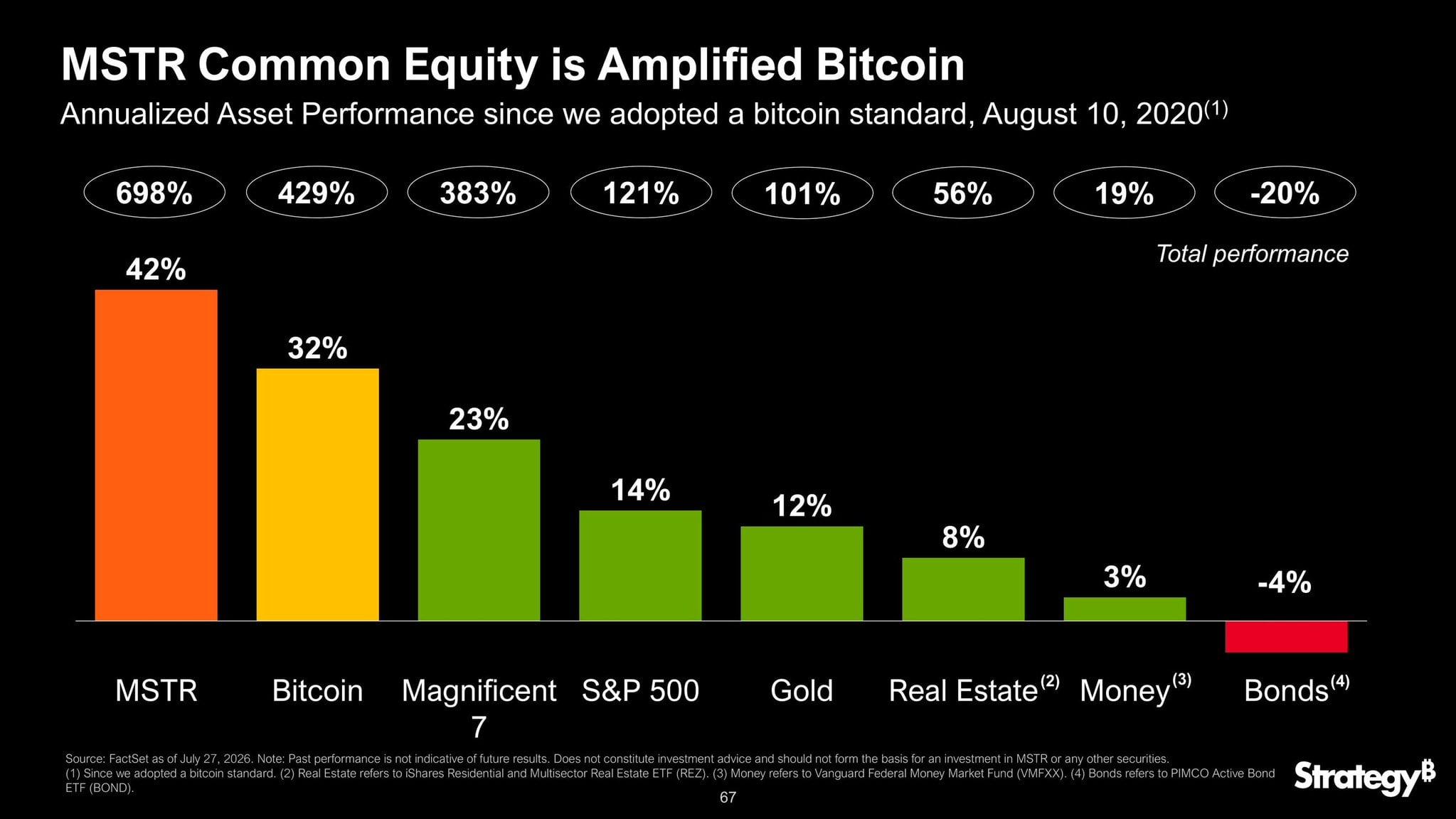
The comparison is one Saylor revives periodically, using MSTR’s five-year stock chart to argue that converting a mid-cap software company into a leveraged bitcoin holding vehicle has outperformed nearly every other asset class available to public market investors. Strategy has circulated versions of the same “bitcoin standard” chart repeatedly since 2025, with the annualized figure shifting as MSTR’s share price swings alongside bitcoin’s.
That volatility has been on stark display in 2026. Strategy’s stock has fallen sharply from its highs even as the company has kept accumulating bitcoin, a divergence that has forced Saylor to introduce new ways of explaining the position to shareholders.
New Metrics for a Complicated Balance Sheet
On July 24, Strategy unveiled a new reporting framework built around Net BTC Per Share, BTC Hurdle ARR and BTC Floor ARR, three metrics designed to show investors what the company’s bitcoin holdings are actually worth once debt and preferred-stock obligations are subtracted out.
Net BTC Per Share works like a traditional book-value-per-share calculation, but denominated in bitcoin instead of dollars. BTC Hurdle ARR represents the annualized bitcoin return Strategy needs just to cover its funding costs, while BTC Floor ARR marks the minimum annual return required to keep the company’s leverage ratio, known as its BTC Rating, at a sustainable 1.0x.
Saylor said the overhaul reflects how much more complex Strategy’s capital structure has become as it has layered multiple classes of preferred stock on top of its original bitcoin bet.
The Treasury’s Other Side of the Ledger
The new framework arrives as Strategy’s underlying bitcoin position sits well below its purchase price. As of July 29, the company holds 843,775 BTC acquired for an aggregate of $63.69 billion at an average price of $75,476 per coin. The numbers leave Strategy with an estimated $11.4 billion paper loss, or about 17.9% below its cost basis.
That gap illustrates the mechanics behind the 42% annualized-return claim. MSTR’s stock, because it trades as a leveraged proxy for bitcoin rather than a direct holding, can post outsized annualized gains over a multiyear window even while the company’s raw bitcoin position is temporarily underwater in dollar terms.
Early Strategy purchases from 2020 and 2021, made when bitcoin traded for a fraction of current prices, still anchor the stock’s long-run return figures even as more recent, higher-priced purchases weigh on the treasury’s average cost basis.
Strategy has continued adding to its bitcoin holdings through 2026 despite the drawdown, with the company recently moving to add $525 million to its dollar reserve (primarily in an effort to shore up dividend coverage on its preferred shares).