
JPMorgan Crypto News: Bank Makes Huge Claim for BTC in 2026
In JPMorgan crypto news today, one of the bank’s top analysts, Nikolaos Panigirtzoglou, has identified two catalysts that will define crypto’s second-half 2026 performance: Strategy’s ability to fund roughly $1.7Bn in annual preferred stock dividends without selling Bitcoin, and US Congressional passage of the CLARITY Act.
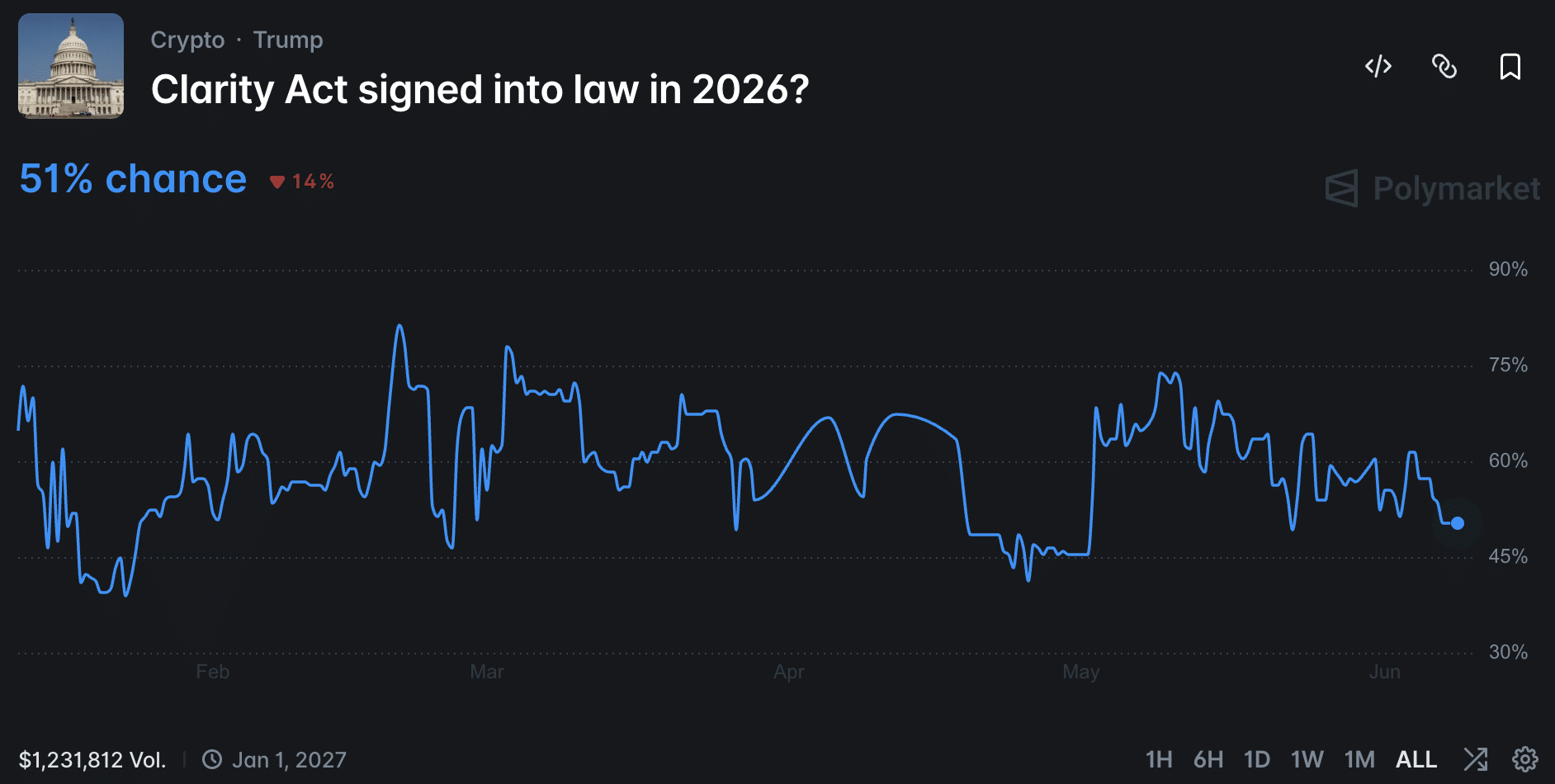
Strategy’s current dollar reserves cover only 6.3 months of those payments. JPMorgan puts the odds of the CLARITY Act passing this year at less than 50%.
The CLARITY Act passed the Senate Banking Committee 15-9, but the clock is ticking.
While Treasury Secretary Scott Bessent targets a summer passage, analysts at JPMorgan put the odds of it actually becoming law this year at less than 50% due to a tightening midterm election… pic.twitter.com/kDFTyzGSBI
— Crypto Wave (@Crypto_Wavee) June 8, 2026
That combination matters for the entire crypto market, not just Strategy’s shareholders. Institutional crypto sentiment has become tightly linked to both the health of Bitcoin treasury balance sheets and the pace of US regulatory reform. When those two pillars wobble simultaneously, institutional capital tends to wait.
Here is the central tension this article unpacks: the two catalysts JPMorgan says crypto needs most in H2 2026 are both now under meaningful pressure, and the market is only beginning to price that in.
JPMorgan Crypto H2 Outlook: What Strategy’s Reserve Problem Actually Tells You
Think of Strategy’s capital structure like a homeowner with multiple loans on a rental property; monthly payments are due regardless of the property’s value. Similar to how mortgage payments persist despite market fluctuations, Strategy’s preferred stock dividends are fixed obligations that must be paid, regardless of Bitcoin’s price.
Strategy, the largest publicly traded Bitcoin treasury company, set up a $1.44Bn reserve in December 2025 to cover these payments. Initially, JPMorgan stated that this reserve would mitigate the risk of forced Bitcoin sales, but it has now dwindled to just 6.3 months of coverage against a ~$1.7Bn annual dividend.
Market attention turned after a sale of 32 Bitcoin on June 3, signaling that Strategy’s commitment to never selling Bitcoin may have changed. This action raised concerns about the need to rebuild dollar reserves to restore confidence and avoid perceptions of future sales.
For a company built on perpetual Bitcoin accumulation, even a small sale can have significant narrative implications. The worry isn’t about today’s sale, but what happens if reserves deplete and larger sales become necessary.
EXCLUSIVE: Earn $10 USDC Via Binance Sign-Up
The CLARITY Act Problem: Why JPMorgan Now Gives It Less Than 50% Odds
The CLARITY Act is a proposed US federal law aimed at clarifying the regulatory jurisdiction over cryptocurrencies by defining which tokens are securities under the SEC and which are commodities under the CFTC.
This distinction is crucial for institutional participants, as it impacts compliance, product launches, and the longevity of business models.
Having passed the House of Representatives, the bill is currently stalled in the Senate due to disagreements over stablecoin rules and agency jurisdiction.
In other JPMorgan crypto news, the bank now estimates the probability of the bill’s passage in 2026 at less than 50%, significantly lower than earlier predictions of above 60%. This shift signals a potential impact on institutional investment in the crypto market.
What JPMorgan’s H2 Warning Actually Means for Crypto Investors
Both catalysts failing simultaneously isn’t the base case; instead, both facing serious headwinds is now the norm. Here’s the scenario breakdown for the second half of the year:
Bull case: Strategy rebuilds dollar reserves through new equity or debt issuance, ending the forced-sale narrative. The CLARITY Act passes the Senate, institutional crypto inflows increase, and H2 exceeds expectations, making JPMorgan’s earlier projection of 2026 inflows plausible again.
Base case: One catalyst resolves while the other doesn’t. Strategy stabilizes reserves but CLARITY stalls, or vice versa. H2 is volatile, with Bitcoin maintaining a range and selective sector gains, but the broad institutional surge anticipated for 2026 does not happen. Inflows continue at around $52Bn annually, below last year’s record.
Bear case: Both catalysts stall. Reserve coverage shrinks, forcing further Bitcoin sales and undermining the treasury model. The CLARITY Act fails to keep institutional capital sidelined, leading to disappointing H2 performance. YTD inflows of ~$22Bn remain at half of 2025’s pace.
Key signals to watch are Strategy’s next capital raise and reserve disclosure. New equity or debt tied to replenishing reserves would alleviate market concerns, while continued reserve shrinkage would increase pressure.
EXPLORE: Best Meme Coin ICOs to Invest in 2026
The post JPMorgan Crypto News: Bank Makes Huge Claim for BTC in 2026 appeared first on 99Bitcoins.